Hello,
This is Medicell Dental Clinic.
Have you ever experienced a sudden sharp sensitivity in your teeth when drinking cold water after returning home from a scaling appointment?
You had the treatment to keep your teeth clean and healthy, so if your teeth suddenly feel more sensitive than before, it is understandable to feel concerned.
“Could my teeth have been damaged during the scaling?”
It is natural for this thought to cross your mind.
In fact, we often meet patients who visit us because they are worried about tooth sensitivity that suddenly appeared after scaling.
However, this reaction is often not caused by damage to the teeth. Instead, once tartar is removed, areas of the tooth surface and roots that had previously been covered may become exposed and begin responding more noticeably to outside stimuli.
Today, we will explain in simple terms why teeth can feel sensitive after scaling and how to tell when it is okay to wait and observe the symptoms.
A Patient Who Returned the Day After Scaling
If you feel a sudden sharp sensation in your molars or front teeth when drinking cold water after scaling, it is easy to become worried.
Especially if you had no discomfort before the procedure, you may wonder:
“Did removing the tartar somehow damage the surface of my teeth?”
This is a question we often hear during dental consultations.
However, when we look at the condition of the teeth and gums before and after scaling, there is another way to understand what is happening.
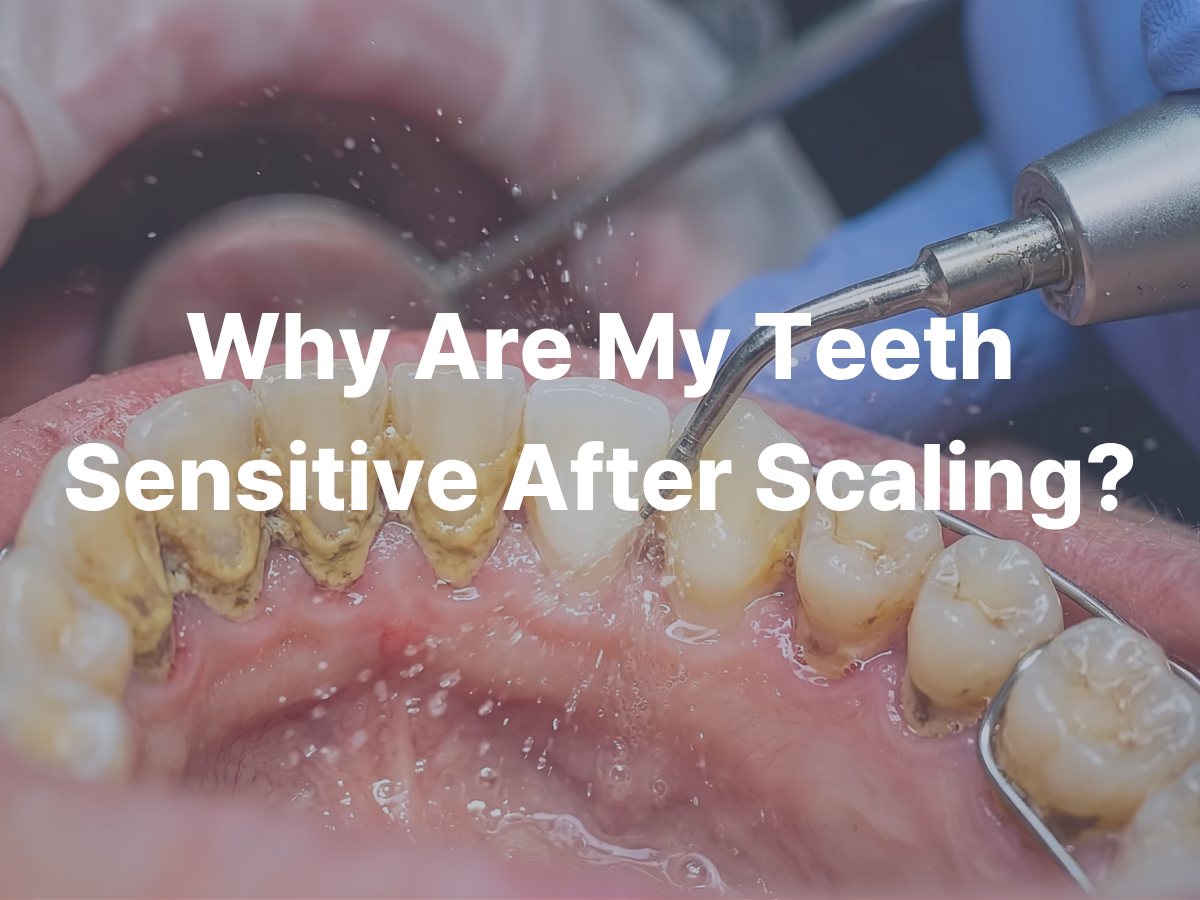
If tartar has remained along the border between the teeth and gums for a long time, parts of the tooth surface or root underneath may have been covered by the tartar.
Once the tartar is removed through scaling, these previously covered areas become exposed.
In addition, as swollen and inflamed gums begin to settle down, more of the root surface may become visible than before.
These areas can be relatively sensitive to temperature changes, such as cold water or cold air.
Therefore, experiencing sudden sensitivity after scaling does not necessarily mean that your teeth have been newly damaged.
Rather, it may simply mean that areas previously covered by tartar are now exposed, making you more aware of sensations that you did not notice before.
Why Do Teeth Feel More Sensitive After Tartar Is Removed?
Tartar is not beneficial to your teeth.
When left untreated for a long time, it can cause gum inflammation and negatively affect periodontal health.
Ironically, however, accumulated tartar can form a thick layer over parts of the tooth surface.
You can think of it as removing a thick layer of buildup that has been covering a window for a long time.
After scaling removes the tartar, areas that were previously shielded from direct stimulation may begin reacting to cold water or air.
The root of a tooth is structurally different from the visible crown of the tooth.
Compared with areas protected by hard enamel, exposed root surfaces can respond more sensitively to temperature changes.
That is why you may experience a brief, sharp sensation when cold water touches the tooth.
Reduced Gum Swelling Can Also Cause Sensitivity
If there was a significant amount of tartar before scaling, the gums may also have appeared swollen and red.
Once tartar and other causes of inflammation are reduced, the swollen gums gradually begin to settle.
As this happens, spaces between the teeth or parts of the tooth roots that were previously covered by swollen gums may become more visible.
From a patient’s perspective, it may feel as though:
“My gums seem to have receded after scaling.”
In some cases, however, what you are seeing is simply the gums returning to a healthier state as the swelling subsides, making the natural shape of the teeth more noticeable.
During this process, the teeth may appear longer than before, or the spaces between them may seem larger.
How Long Does Sensitivity After Scaling Last?
Because everyone has a different amount of tartar and a different level of gum health, it is difficult to give one exact recovery period that applies to everyone.
In general, your teeth may be somewhat more sensitive to cold foods, drinks, or brushing for several days after scaling.
What matters most is whether the sensitivity gradually becomes less intense over time.
For example, if drinking cold water caused significant sensitivity yesterday but feels slightly better today, this may indicate that the teeth and gums are gradually settling down.
On the other hand, if the discomfort remains unchanged or becomes increasingly painful, another cause may need to be investigated.
If tartar had accumulated deeply below the gumline, sensitivity may also last somewhat longer than after routine scaling.
How to Care for Sensitive Teeth at Home
Even if your teeth feel sensitive immediately after scaling, avoiding brushing altogether is not recommended.
Instead, the key is to reduce the amount of pressure you use.
Choose a toothbrush with soft bristles, and when cleaning along the border between the teeth and gums, brush gently rather than scrubbing with force.
Using toothpaste designed for sensitive teeth may also help.
For a few days, it may be more comfortable to avoid foods and drinks with extreme temperatures, such as ice-cold water or very hot soup.
Carbonated beverages and highly acidic foods may also irritate sensitive teeth during this period.
After eating, gently rinsing your mouth with water can also be helpful.
When Should You Have the Pain Checked Again?
There is one important distinction to keep in mind.
Tooth “sensitivity” and tooth “pain” are not necessarily the same thing.
A brief, sharp sensation that occurs when cold water touches a tooth and quickly disappears is different from persistent throbbing pain that occurs even when you are not eating or drinking anything.
If one particular tooth is significantly more painful than the others, or if you repeatedly experience sharp pain when chewing, it is a good idea to have it checked.
If the pain is severe enough to wake you at night, or if pain triggered by hot foods or drinks lingers for a long time, it is better not to assume that it is simply temporary sensitivity following scaling.
Problems that were already present, such as a small crack in the tooth, tooth decay, or gum inflammation, may become more noticeable after tartar has been removed.
Scaling Does Not Weaken Your Teeth
When sensitivity develops after scaling, it is natural to wonder whether the treatment itself caused the problem.
“Was some of my tooth removed along with the tartar?”
This is another concern we frequently hear in the dental office.
However, the purpose of scaling is to remove tartar and deposits that are firmly attached to the teeth.
Leaving tartar untreated is actually more harmful to gum health.
Therefore, temporary sensitivity after scaling does not mean that you should avoid scaling in the future.
What Matters Most Is How the Sensitivity Changes
There is one final point we always emphasize to our patients.
Rather than simply counting how many days your teeth have felt sensitive, pay attention to how the discomfort is changing.
If your teeth are gradually becoming more comfortable, it is likely that your teeth and gums are simply settling down after the procedure.
However, if the pain is worse today than it was yesterday, or if strong pain repeatedly occurs in one specific tooth, the situation may be different.
In that case, rather than enduring the discomfort and continuing to wait, it is a good idea to have the condition of your teeth and gums checked.
Scaling is not simply a procedure for removing tartar.
It also gives us an opportunity to examine the condition of the teeth and gums that may previously have been hidden beneath tartar buildup.
If your teeth feel sensitive after scaling, you do not need to immediately assume that something went wrong with the treatment.
Instead, pay attention to whether the signals your teeth are sending become weaker day by day.
Is it just a brief, sharp sensation, or is it persistent pain?
Simply knowing the difference can help reduce unnecessary worry after scaling.
Thank you.
Medicell Dental Clinic