Hello.
When patients visit our clinic because of swollen or bleeding gums, I often hear questions like these.
“Doctor, won’t scaling alone solve the problem?”
“I thought removing tartar would also get rid of the inflammation.”
Hearing these questions reminds me that many people think scaling and gum treatment are the same thing.
That is why I do not begin by talking about scaling.
Instead, I first examine the condition of the gums and determine how far the inflammation has progressed.
Even when the symptoms look similar, the underlying cause can be very different.
A Patient Who Came in for Scaling
Not long ago, a patient visited our clinic after noticing bleeding while brushing for several months.
There was no pain, so the patient assumed it was simply caused by fatigue and believed it would disappear with time.
Eventually, the gums began to swell more frequently, and persistent bad breath became another concern.
The patient decided it was finally time to schedule a scaling appointment.
Before beginning the examination, I said,
“Before deciding whether scaling is enough, let’s first take a close look at the condition of your gums.”
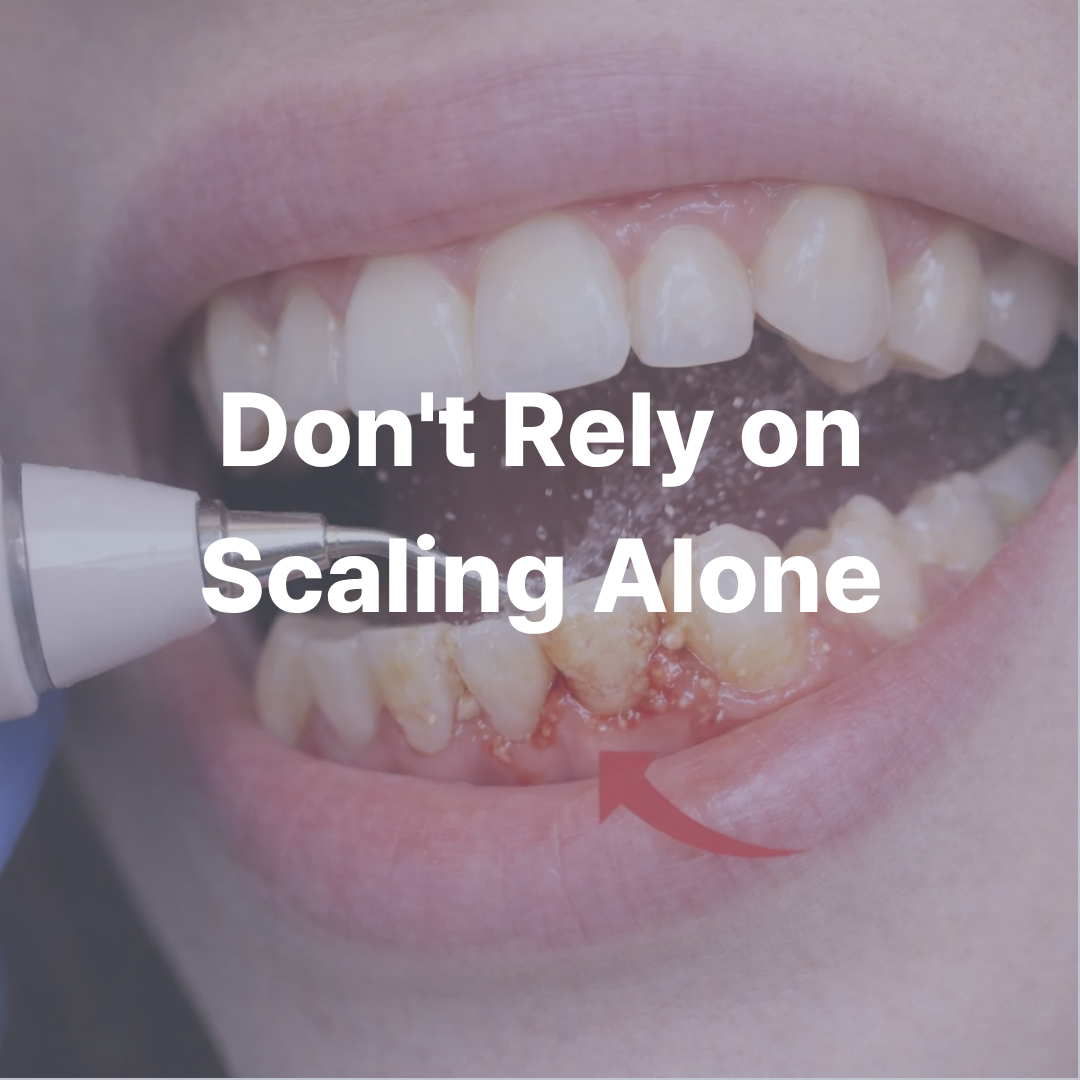
During the examination, we found that the real problem was not the tartar visible above the gum line, but the tartar and inflammation hidden beneath the gums.
After seeing the images together, the patient quietly replied,
“Now I understand why scaling alone might not be enough.”
Conversations like this happen more often than many people realize.
When Scaling Alone Can Improve Gum Inflammation
If gum inflammation is still in its early stage, scaling alone may be enough to help the gums recover.
Tartar is hardened dental plaque that has accumulated over time.
As tartar builds up, it continuously irritates the gums, causing swelling and bleeding.
Once the tartar is removed, the source of irritation disappears, allowing the gums to heal naturally.
It is similar to cleaning a dusty window. Once the dust is removed, the glass becomes clear again.
Many patients with early gum inflammation experience significant improveme
When Scaling Alone Is Not Enough
However, not all gum inflammation is the same.
Some patients continue to experience swollen or bleeding gums even after visible tartar has been removed.
In many of these cases, tartar remains deep below the gum line.
Although it cannot be seen with the naked eye, inflammation continues beneath the surface.
Patients often ask,
“I had scaling recently. Why are my gums still bleeding?”
In many situations, deeper periodontal treatment is needed to remove tartar hidden beneath the gums.
Imagine cleaning the floor while leaving all the dust under the sofa untouched.
The room may look clean, but the hidden dirt remains.
Likewise, gum inflammation may continue unless the underlying cause is properly treated.
Daily Habits Also Affect Gum Recovery
Treatment alone is not enough to keep your gums healthy.
If brushing is incomplete or floss and interdental brushes are not used regularly, tartar can build up again.
Smoking can slow the healing process, and systemic conditions such as diabetes may also affect gum health.
That is why maintaining good oral hygiene after treatment is just as important as the treatment itself.
Healthy gums are built through consistent daily care.
If These Symptoms Continue After Scaling
It is normal to experience temporary sensitivity or slight bleeding while the gums heal after scaling.
However, if discomfort continues, it is worth having your gums re-evaluated.
If your gums continue to bleed whenever you brush, the inflammation may not have fully resolved.
Frequent swelling or tenderness may indicate that tartar remains beneath the gums.
Persistent bad breath can also be associated with inflammation deep inside the gum tissue.
If your teeth begin to feel loose, the condition of the supporting bone should also be examined.
If bleeding, pain, or swelling continues after scaling, it is better not to assume it is simply part of the healing process.
A professional evaluation can determine whether additional periodontal treatment is necessary.
Your gums often send small warning signs before more serious problems develop.
Identifying the cause early can help preserve your natural teeth for many years.
Accurate Diagnosis Comes Before Scaling
Not every case of gum inflammation is serious.
Likewise, it is difficult to say that scaling alone will solve every problem.
The most important step is understanding the current condition of your gums.
Only then can we determine whether scaling is sufficient or whether additional periodontal treatment is needed.
In my practice, I do not begin by recommending scaling.
Instead, I first listen to what the gums are telling us.
Removing tartar is important, but understanding why the gums are swollen and bleeding is even more important.
Finding the cause is the first step toward protecting your natural teeth for the long term.
Thank you.
Treatment begins with careful explanation and genuine care.
To help preserve your natural teeth and avoid missing the critical timing for treatment, I believe in making treatment decisions together with every patient.
Dr. Han Hyun Woo
Medicell Dental Clinic